Product Condition Belongs in the Commerce Decision
Aeris Team
Aeris Editorial
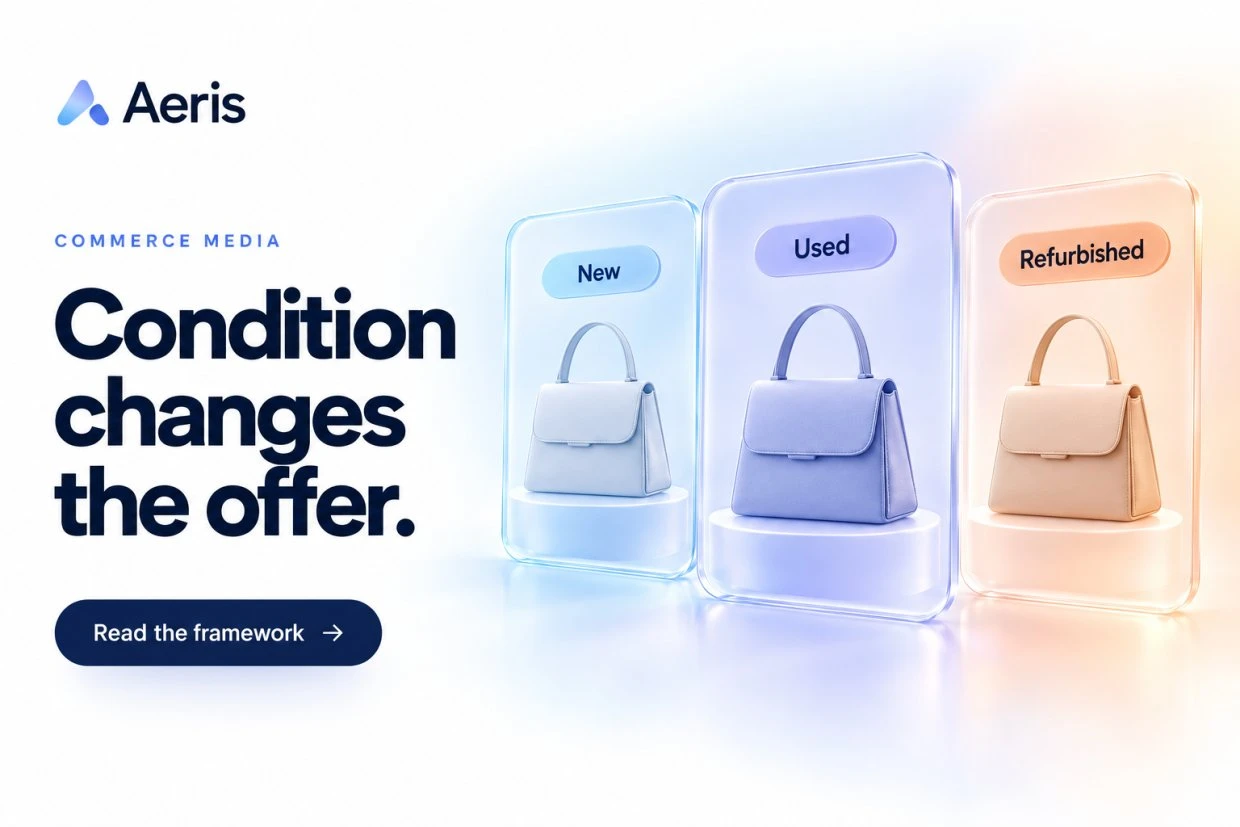
Two offers can share a brand, model and photograph while representing different buying decisions. One item may be new, another used, and another professionally refurbished. A price comparison that hides that distinction asks the shopper to discover an important qualification after the click.
For commerce media and AI shopping teams, product condition belongs beside the offer. It should remain visible as information moves from merchant records into discovery, campaign selection and the destination experience. The goal is not to decide which condition is better. It is to help the customer understand what is being compared.
Keep the source meaning intact
Google Merchant Center documents a condition attribute with new, refurbished and used values. Its guidance requires the attribute for used and refurbished products, while making it optional for new products. Its definitions describe different product states, so teams should consult the current specification rather than invent a convenient mapping. Google Merchant Center
That platform guidance provides a concrete starting point. The workflow below is our operational interpretation for commerce teams, not a claim that every marketplace uses identical labels. A merchant's detailed condition description may contain information that a short destination field cannot express.
Preserve detail before normalizing
Start with the source record and preserve the original description alongside any normalized category. This lets someone investigate how the classification was chosen. A transformation that discards the source wording can make an incorrect mapping difficult to trace.
When a record is ambiguous, route it for review instead of confidently guessing. A title containing a promotional adjective is not always enough to establish the condition. Teams should define which source is authoritative and who can resolve an unclear entry.
In a hypothetical catalog, two bags share a model name but differ in wear and included accessories. Their model identity helps discovery, yet it does not make the offers interchangeable. The listing needs enough detail for the buyer to recognize the distinction.
Make the comparison explicit
A comparison experience should tell the shopper which differences matter before presenting a simple ranking. If the requested product must be new, a lower-priced used offer should not silently satisfy the request. If alternatives are welcome, show that the comparison includes different conditions.
The same discipline applies to generated summaries. A fluent sentence should not erase a qualification present in the source. Review whether the summary preserves the condition and whether the destination supports the statement.
Do not infer that a particular condition automatically produces a better commercial result. Customer needs, price, trust, service and availability all affect the decision. The content should support an informed choice rather than turn a category into an unsupported quality claim.
Review the destination as part of readiness
Follow a representative offer from the campaign record to the landing page. Check that condition is visible, consistent and associated with the same item. Inspect relevant photographs and descriptions instead of relying solely on a generic product image.
Record any mismatch with the source reference and observation time. Identify whether the problem began in merchant data, a transformation, campaign selection or presentation. Fixing the earliest incorrect step reduces the chance that the next refresh restores the mistake.
For an AI-assisted workflow, test the explanation as well as the link. Ask the system to describe what the customer will receive and compare its answer with the verified source. Keep uncertainty visible where the underlying record does not support a stronger statement.
Keep reporting groups understandable
Separate materially different offer groups when reviewing campaign results. A change in the mix of conditions can complicate a comparison between periods, even if the campaign name stays the same. Preserve the mix beside headline metrics.
This is a diagnostic practice, not a promise that segmentation will improve performance. Use it to identify the next question: did the audience change, did the offer change, or did the destination create confusion?
Begin with one important product group. Document the source mapping, inspect the customer-facing comparison and resolve the ambiguous records. A useful completion test is whether another teammate can explain exactly what each offer includes without reconstructing the entire data pipeline.
Source reviewed September 20, 2026. The workflow and hypothetical example are Aeris editorial analysis.